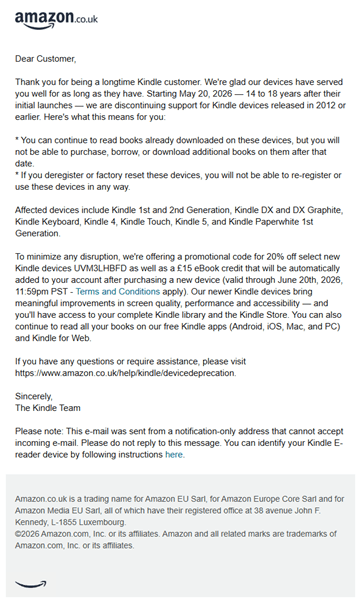
Earlier last week I, like many Amazon customers, received an email from Amazon about my Kindle e-reader device:
I’ve owned a Kindle 4 since October 2011. For years, this was the device I read books with (I’ve since gone back to paperback books). It’s still technically functional but lives in a battered case, the battery life isn’t near as legendary as it once was, and indeed it hasn’t been able to connect directly to the Amazon storefront for a while anyway.
Amazon has confirmed in the email that Kindles from 2011 and earlier – including mine – will lose support in May 2026, and this has predictably created some dramatic reaction online. I think a lot of that reaction missed what’s actually going on here, which is this:
- Kindle devices manufactured in 2012 and before are considered “out of support” after May 20th 2026.
- This means these devices will no longer be able to access the Amazon web store through their integrated operating systems (if they still could. My Kindle 4 is no longer able to access the storefront directly)
- It will no longer be possible to push downloads using the Kindle website to these devices. Books and documents that are already downloaded will remain readable.
- Any attempt to factory-reset or deregister these old devices will render them unusable – or “bricked”.
“My Kindle Works Perfectly Well!”
The most common complaint seems to be “well, my old Kindle still works fine, why do I have to replace it?”
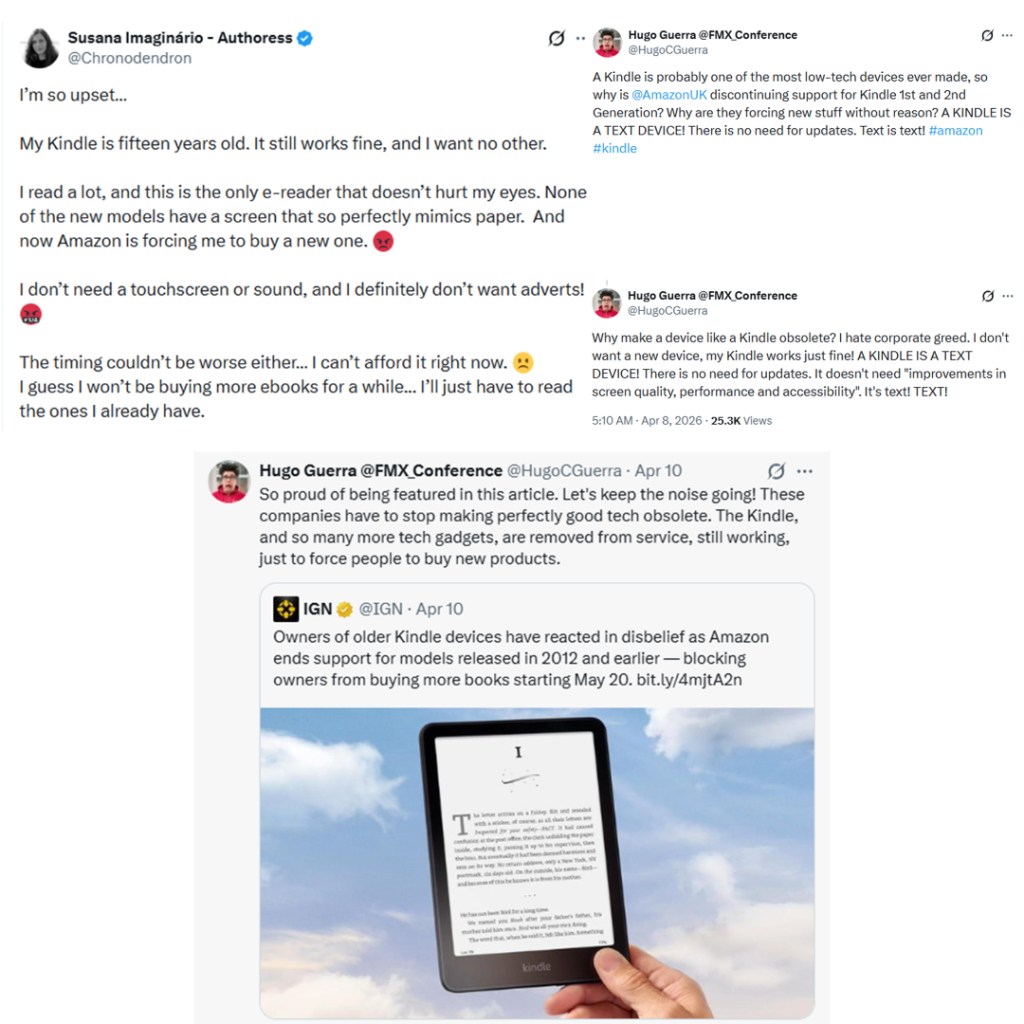
I get it, to a point.
Indeed, I’m writing this blog post on a keyboard that’s older than some of the people who have been complaining, so yes I have a soft spot for old technology that was built to last and I hate waste – I’m often hesitant to replace things that do still do the job they were designed to.
However, these old devices by their very nature are obsolete.
These old Kindles still open ebooks, yes; but everything behind that making that possible – the Kindle Store, account services and even connecting to new Wifi standards – has moved on massively since those original devices came out. At some point the old hardware and software can’t keep up any more.
Things have changed in so many ways since these initial pioneering devices were launched, in ways I feel many consumers may not be aware of. Technology has evolved, again in ways we cannot always see in front of us.
Kindles don’t just “magically” connect to Amazon’s store – there is a whole backend infrastructure that must be maintained. These old devices may no longer support the technologies that Amazon now uses for their backend infrastructure, and this cannot be maintained forever.
It’s the same as starting up an old Windows XP machine – it’ll start up, boot, and it might even feel fine and look functional, but behind the scenes the technology is antiquated (especially security technology) and it simply isn’t able to support modern standards that are from a world that Windows XP wasn’t designed to even be aware of. Yes, you can patch that on (to a degree) but at some point we have to admit that the technology behind Windows XP is too antiquated to keep patching to support more and more modern standards.
And then you’d open Internet Explorer 6 and find no modern websites work because Internet Explorer 6 can’t understand them.
Being forced to maintain these legacy systems – by always looking back, not forward – stymies innovation and improvement.
Think of how the UK NHS was using outdated fax machines until not that long ago; or more aptly, how authors and readers grumble on the daily about Goodreads being hard to use – because it uses an antiquated backend system that simply can’t be adjusted for the modern internet. I mean, look how long it took for Goodreads to add an official “did not finish” shelf/option?!
This is all supposition, though; I feel Amazon’s communication as to why this has been decided has been lacking, which has left an information void that has been filled with disinformation and misinformation.
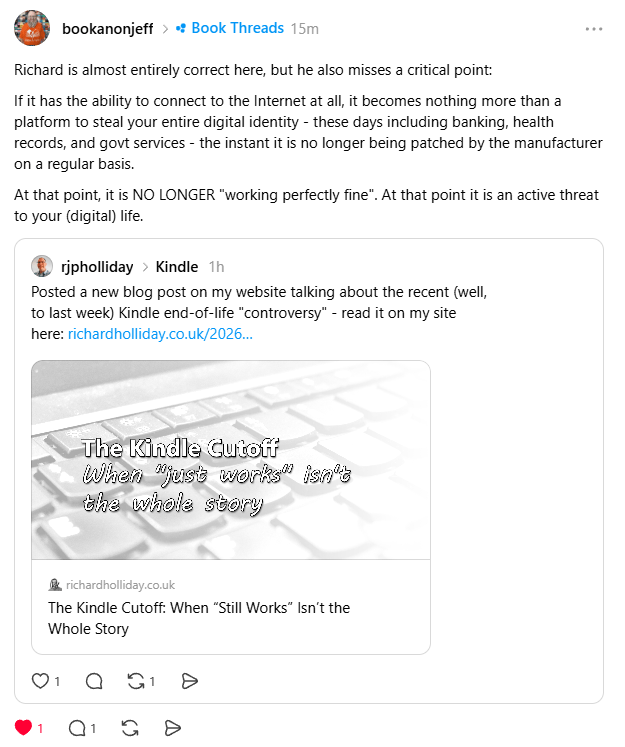
UPDATE: As pointed out by Threads user BookAnonJeff – it’s more than just functionality – an internet-connected device that is no longer supported by its manufacturer for security patches is dangerous to use as, without ongoing support, it becomes a vector for identity theft through nefarious players. Unless air-gapped and never connected to the Internet, unsupported devices (such as the Windows XP example above) should never be connected to the internet. Thanks, Jeff, for your valuable input!
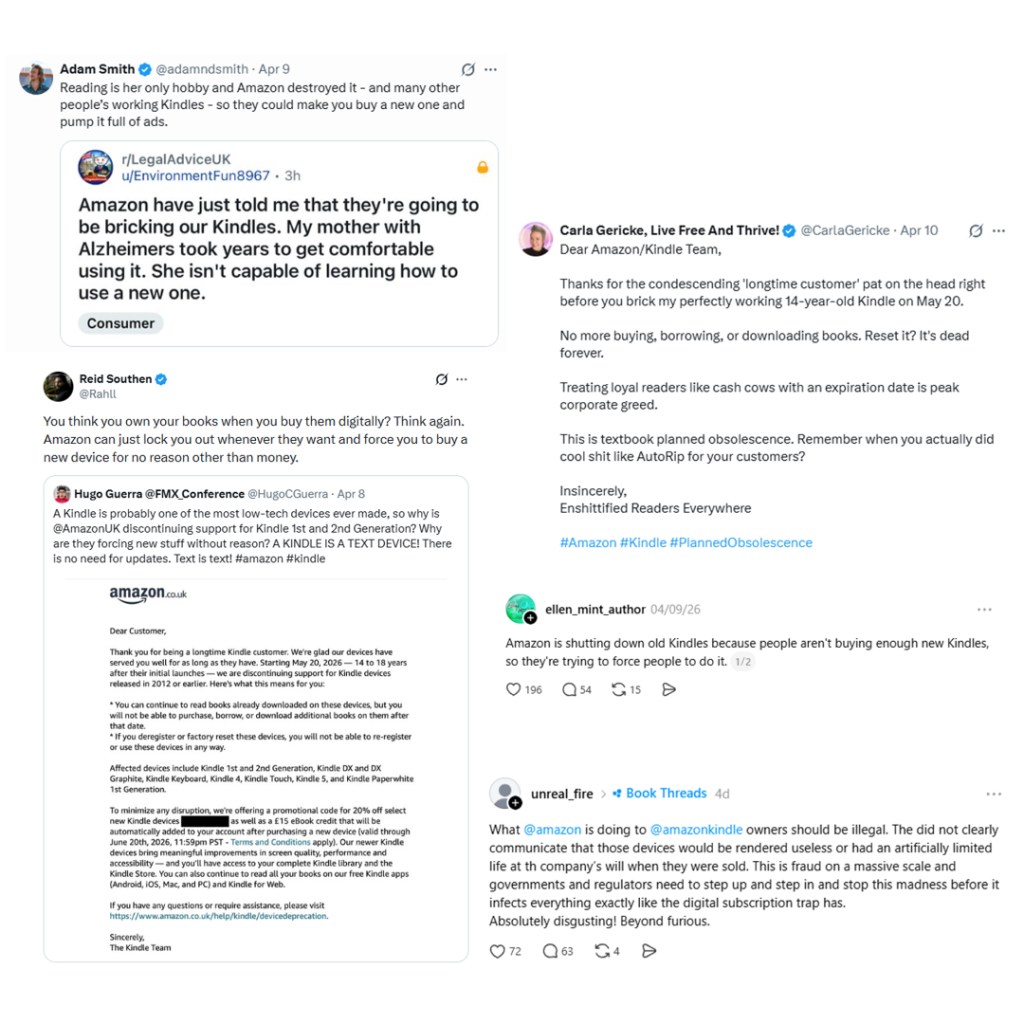
“Amazon Just Wants to Sell New Kindles!”
Amazon has never made its real money on Kindle hardware. Instead, it makes it on the books – the device you buy at a very cheap price is just the gateway into the ecosystem.
Gilette sell its razors relatively cheap because once you have that razor, you’re locked into buying their blades.
If the goal was to push people into buying new Kindles, Amazon could have done this years ago; instead, these old devices have been supported for well over a decade, and some for almost twenty years.
For tech, that’s a very good run, and not one you see often.
Compare this to smartphones which typically lose software support after 4 or 5 years if you’re lucky – even if they continue to “work perfectly well”. By that point, people are getting shiny thing syndrome and eyeing up and upgrade anyway.
It’s funny how that’s just accepted as the nature of mobile phone ownership where a 15-year old Kindle reaching the end of the road isn’t. Why aren’t we more outraged about phones? Maybe we’ve just become begrudgingly accepting?
“It’s Making a load of e-Waste!”
Nobody likes unnecessary waste, least of all me. Remember, I’m writing this blog on a keyboard made in 1992.

Amazon has worked hard to reduce e-waste by supporting these devices for nearly twenty years – this is the polar opposite of “disposable tech”. Maybe that’s why people have become attached to these things?
Most consumer technology doesn’t come close to that kind of lifespan – because the companies want you in that constant upgrade cycle. Most technology is really designed to be disposable, which is a shame.
And people tend to get that shiny thing syndrome over the next new thing anyway.
I’ve owned 4 iPhones since 2012 – an iPhone 4S, an iPhone 6S, an iPhone 13 and my current iPhone 17. I make those devices last for about 5 years each, and I get good value from them (they’ve also all been fantastic phones but they were upgraded at the right time).
If anything, the support Amazon has given these device has been a refreshing positive – consider how the hardware requirements for Windows 11 has often been criticised as artificially and needlessly creating e-waste from machines that run Windows 10 “perfectly well”.
There’s that term again – “perfectly well”.
Am I Defending Amazon?
Not really. Amazon has its issues and I’m not unaware of the wider criticism of its business practises, especially for authors.
But here, I don’t think the outrage holds up.
I do feel Amazon could’ve communicated the reasons why better and this would’ve headed off a lot of the confusion and drama. However, this information gap has been filled with quite a lot of supposition, misinformation and disinformation about the reasons.
“Perfectly Well”
This phrase keeps coming up – “it still works perfectly well”.
From a narrow point of view, that’s true – the screen turns on, books open, and from the outside, everything looks fine. Why are we changing?
That’s the surface view.
If you can’t see the moving parts, it becomes easy to assume there aren’t any.
Part of the issue, I think, is that technology has become so easy to use that most of the complexity is completely hidden. This leads to technology being accessible but to users being uninformed. They don’t have to think about how it works. It just does.
Therefore, changes like this that are most likely for completely legitimate technical reasons feel arbitrary, even when they aren’t.
If the device still turns on and does its basic job, why should anything change?
Of course, the visible part we interact with as end users isn’t the whole system.
I grew up in the 1990s,where getting a computer to behave often involved trial and error, and these machines could be completely byzantine to the uninformed user. You’d have to ask for help or refer to the manual when it went wrong or muddle through. Whether you liked it or not, you were a bit closer to how things worked.
My first computer ran Windows 95 – which was already a step up from the previous DOS operating system. I still remember having to ask my dad to help me install games on DOS as it was too scary to do it myself. I kept thinking I’d break something! Windows 95 made it easier, but there was still plenty of opportunities for mishaps and a basic level of knowledge was still expected.
These days everything is far more polished. It just works, which is great right up and until it doesn’t, and the reasons why aren’t immediately obvious.
When older devices lose support – which is a perfectly normal part of the tech life cycle, it can feel like it’s being taken away for no good reason.
Conclusion
At the end of the day, this isn’t really about Amazon being greedy or trying to force people to upgrade.
It’s about the simple reality that technology moves on.
These older Kindles haven’t suddenly stopped working, but the systems around them have moved on, and expecting indefinite support just isn’t realistic.
Technology doesn’t stand still.
If anything, these devices lasting nearly 20 years is an exception, not the rule. It’s actually been a good ride.
While it might be frustrating, especially in these trying times we live in, it’s not the sign of anything sinister.
They still “work perfectly well” in the narrow sense, but that was never the whole story.


Leave a Comment