I recently read a blog post by fellow indie author Ryan M. Patrick about “inefficiency” in writing. He reflected on why he has written far more words than he has published.
What struck home with me was his observation that his outlines are extremely “light” – so light that many of the main story decisions end up being deferred until the drafting stage. That post made me reflect upon my own writing progress because I have found myself facing a slightly different but adjacent problem: editing.
Ray of Light now requires another edit following some feedback I received from a trusted critique partner – and it’s led me to delay the planned release by a month as I know in my heart-of-hearts, for this book to meet the quality standard I want, and to avoid burning myself out to meet my previous deadline, it needs the additional time.
However, this is not really the scope of this post.
Editing is a process I realise is necessary, but I’ve never particularly enjoyed it. To me, it feels like fiddly work – correcting details, reconciling inconsistencies and untangling things that probably should’ve been clearer earlier. Editing also feels like I’m playing Jenga with my story – one small change create more problems or collapse the narrative entirely, and getting out of that quicksand is not fun. As such, I’ve been considering my writing process and wondering how I could improve this to… not totally avoid editing but perhaps arrive in a place where editing is less drudgery for me. I’d want it to be something I dread less, and enjoy more.
Outlining
The more I thought about it, the more I realised that many of the “problems” I end up having to fix in editing actually originate much earlier in the process, during the outline phase.
Back in 2010 when I made my first “proper” attempt at novel writing as part of NaNoWriMo (which is now defunct), I was a pantser – that is, I just opened a blank Word document and started writing. The book I wrote in 2010, a steampunk adventure entitled The Last of the Steamers was a hot mess. Even when I tried to edit it later, the problems were so structural that it became clear that the book would need a complete rewrite – keeping only the core idea and starting again, which isn’t something I’m unfamiliar with lately, but would require a lot of commitment. I do think the core story is solid and we’ll just put that on the “maybe” pile!
So I relate to Ryan’s point about “wasted” words (though I take all of those projects as “learning experiences” too)!
In recent years I’ve turned in the opposite direction to become an assiduous outliner – I plan my novels around the Five Commandments of Story structure, and my workflow is this:
- Write a narrative concept of everything I want to happen in the story – my “initial outline”.
- Break this down into what happens per point of view for the five acts
- Break this down to scene level for each chapter.
When I first tried using a beat-sheet/outline like this, for Nightmare Tenant, I found this made the drafting process drastically easier and faster, and because of that, I have used the method for each project going forward, while tweaking it slightly.
However, I am a very light outliner and my scene notes are usually very brief – a statement of what I generally want to happen in each scene. Here is an example from the Boat Party outline:
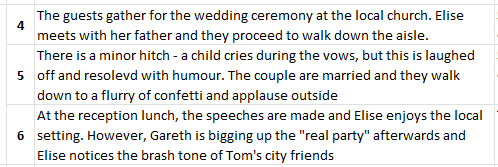
These scene notes act as guides for what I generally think should happen in each scene – it leaves a lot of latitude for scenes to develop naturally; however I do feel this leaves a lot of room for me to go off-script, to “colour outside of the lines” because the detail I need is not there in advance and I’m leaving myself to freestyle – to pants – the actual scene – and as I’ve realised, pantsing my writing may be fun in the moment when I’m laying down words with wanton abandon… this makes my editing job a lot more difficult.
To use the example above, I am going to demonstrate how I could have outlined those three scenes better:
Scene 4: Arrival at the Wedding
- The guests gather outside St Barnabas-on-the-Green church in anticipation of the arrival of the bridal party
- Elise and her father are approaching in the car and have a final, personal conversation
- Elise is guided into the church
- She walks up the aisle toward the altar and sees Tom for the first time
Scene 5: The Vows
- The vicar begins the ceremony
- At the lawful impediment moment there is an interruption – a child of an attendee having an unfortunate accident. This is laughed off.
- The ceremony is concluded. Elise and Tom are married, despite the interruption. (This is foreshadowing)
Scene 6: The Reception
- At the Banstead Arms hotel, Gareth (best man) makes his speech.
- The speech is reverent toward Tom but contains veiled slights toward Elise (who Gareth is implying is plain and boring, not like Tom’s new City friends)
- This leaves Elise feeling self-conscious and uncomfortable
For Boat Party I have also added Location and Time columns, and regrettably during the outlining phase I did not make use of these as assiduously as I could’ve done and already in the draft I can see there’s going to be some issues to resolve in making sure everything is properly lined up chronologically to make the story work as I intend it to.
The Devil is in the Detail
I also recognise that as I am drafting, I am not tracking minor details effectively enough to ensure consistency across scenes and characters – and this deficiency in my process is leaving me too much scope for details going askew – an eye colour here, a character name there… and this contributes to a lot of the perceived drudgery of editing.
In writing this post I’ve reflected a bit on how I could mitigate this.
I think I need to rethink my outlining spreadsheet to have an additional tab – currently there is one tab with the scene outlines and a tick box for “written?” which feeds into my progression dashboard for the project as well as the predicted word count.
Usually I don’t really need to look at this information as I draft. When I set up a scene to draft, I will copy the outline into the Scrivener synopsis area and I only update this with a tick for scene written and the scene word count (which now goes into my final word count prediction) and completion statistics. When I’m actually drafting, this information is not something I am needing to keep a direct eye on as it’s been copied into my writing environment.
What I think would be helpful is a separate tab on this spreadsheet primarily aimed at drafting – I can track by either scene or chapter and log:
- Time scene takes place in
- Location
- Present characters
- Notable attributes (clothing, eye colour, any injuries etc)
This information needs to be readily accessible, searchable and relevant and it needs to be easy to update, as if a process is too cumbersome or onerous then it will fall by the wayside and be of no use to me whatsoever.
I also feel I should build into this a list of ready-to-use assets such as:
- An index of characters so I don’t have to go looking up people’s names (or, as has happened, just give them a new name which then becomes an issue to resolve later)
- Placeholder character names I can drop in when I need an ancillary character name
- Places
Conclusion
Overall, I want this to help me to write better books without having to fear or loathe the perceived drudgery of the editing process, and to make me write cleaner drafts that require less editing.
I think there is a perceived notion that to write means you have to be writing (as in writing words) – and nothing else. However, in order for writing projects to be successful, careful administration of both the project before a word is drafted and after is just as important – like packing for a holiday, you don’t just leave it to the night before if you don’t want to be surprised you’ve left your pants at home.
What I’ve taken away from this reflective exercise is not something I am going to be able to retroactively do for my current projects as that would be horrendously onerous and would add to my worry about taking time away from writing, which I know is false.
I do however think this is going to be a worthwhile endeavour for future projects.
 Richard Holliday - Author
Leave a Comment