My writing process often ends up at a place where art and science meet.
In August last year, I completed the first full draft of Legacy of Iron, a project I’ve discussed in earlier posts. The first incarnation was going to be written entirely “old school” on my IBM Wheelwriter electronic typewriter. I later restarted the project from scratch, but the typewriter dream never completely died — and for a few scenes and chapters in the rewrite, I went back to it simply because I felt like it.
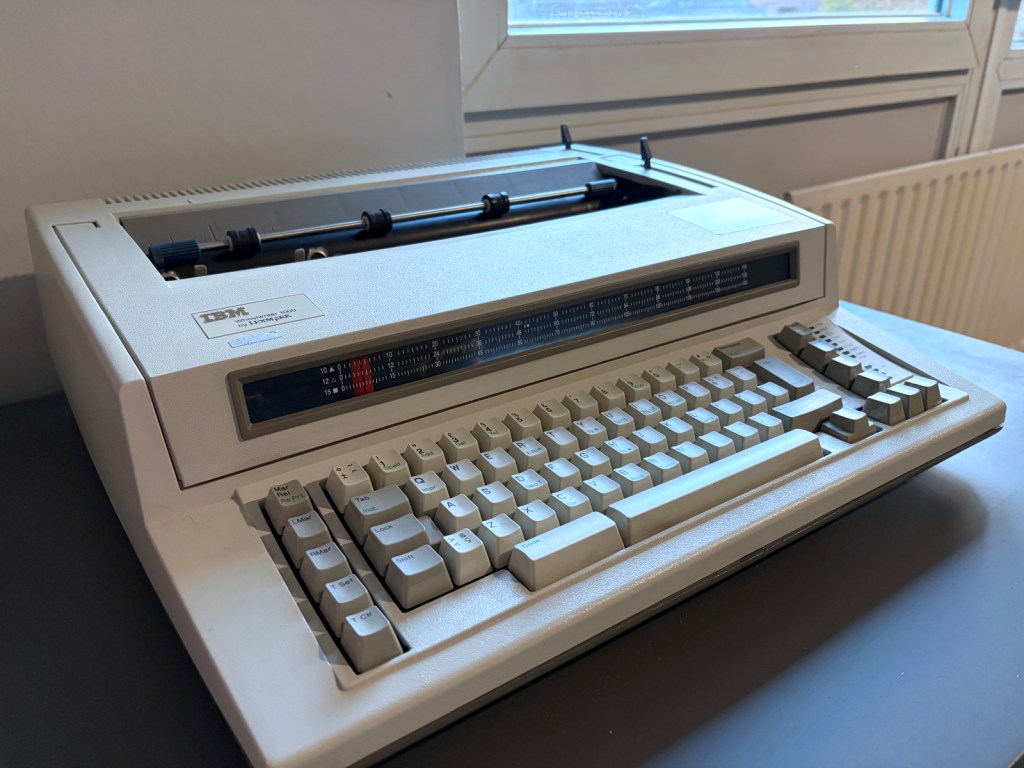
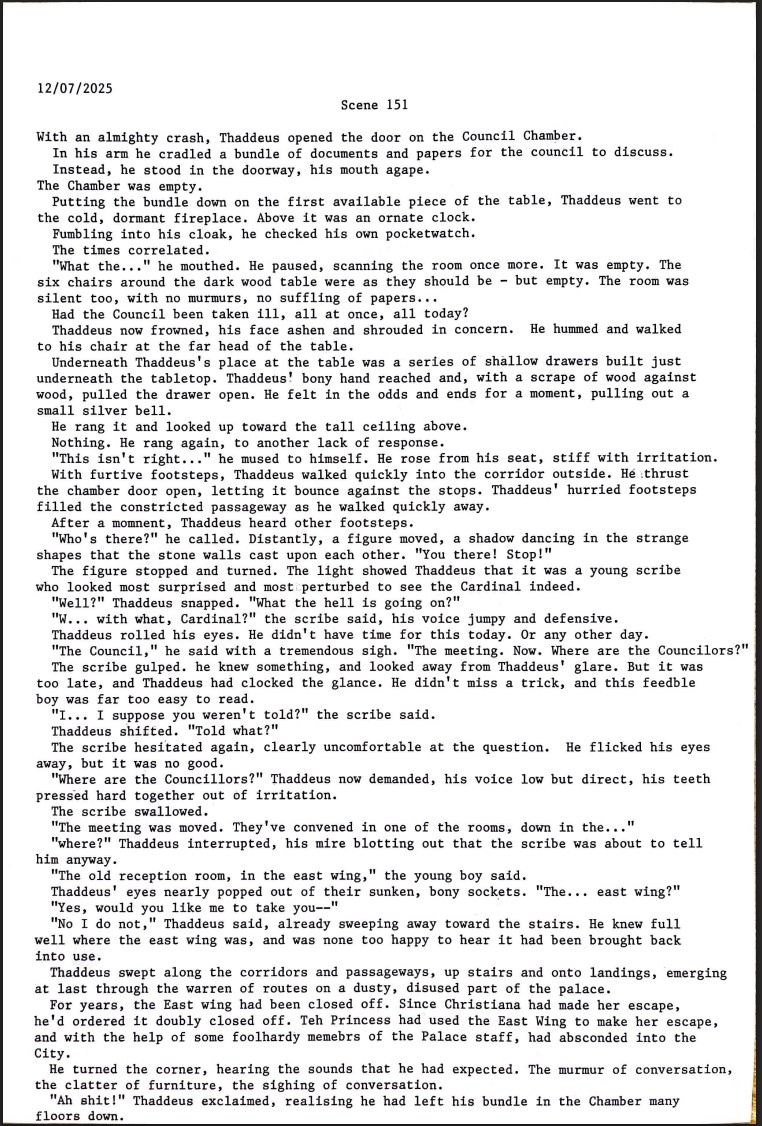
My plan for those typewritten pages was simple: scan them, run them through OCR, and convert the PDFs into selectable text I could paste straight into my manuscript. That worked (sort of) but only for a handful of pages. Beyond five or six pages, it became a frustrating mess.
- I used double quotes on the typewriter, but my manuscript uses single quotes, which is the standard UK style. The Wheelwriter’s keyboard layout puts the single quote above the 7 key, so double quotes were simply easier to type.
- Each paragraph had a manual indent, which meant the OCR output wasn’t “reflowable” like normal text.
- The recognised text was forced into Courier to mimic the typewriter’s monospaced font.
The OCR did its job too literally, copying every space, font, and quote mark exactly as seen on the page. Fixing that meant converting every quote, cleaning up errors, and reflowing the text by hand. This was fine for a few pages, but impossible for a whole novel. It would have added months of dull, repetitive work and probably introduced more errors in the process.
What I needed was a way for the computer to not just recognise the text in the pages I was scanning, but also to process the words to fit the rest of my manuscript without me needingto do all this “donkey work”.
Then I realised there was such a tool: generative AI.
There’s plenty of controversy around AI in writing. This post isn’t a deep dive into that debate: it’s a broader and more nuanced subject than most people give it credit for. But I do think AI has its place in some aspects of the writing process, especially in the more administrative side of writing.
I realised that I could use generative AI – ChatGPT in my case – to both do the OCR aspect of this task and some basic formatting tasks to produce, in seconds, a clean digital version of my scanned pages that:
- Removed any stray OCR artifacts
- Converted straight double quote (“) characters to the correct, context-sensitive curly single quote characters (‘) to match the rest of the manuscript
- Replaced double hyphens (- -) with em dashes (—) to work around a limitation of the Wheelwriter
- Made paragraphs flow properly with first-line indents rather than manual tabs
I explicitly told ChatGPT not to correct spelling or grammar errors, as that’s work for my first proper edit later. I didn’t want it guessing at my intent or rewriting my prose. All I needed was a cleaner, more convenient format for integrating the text into my main manuscript.
I was extremely impressed with the results:
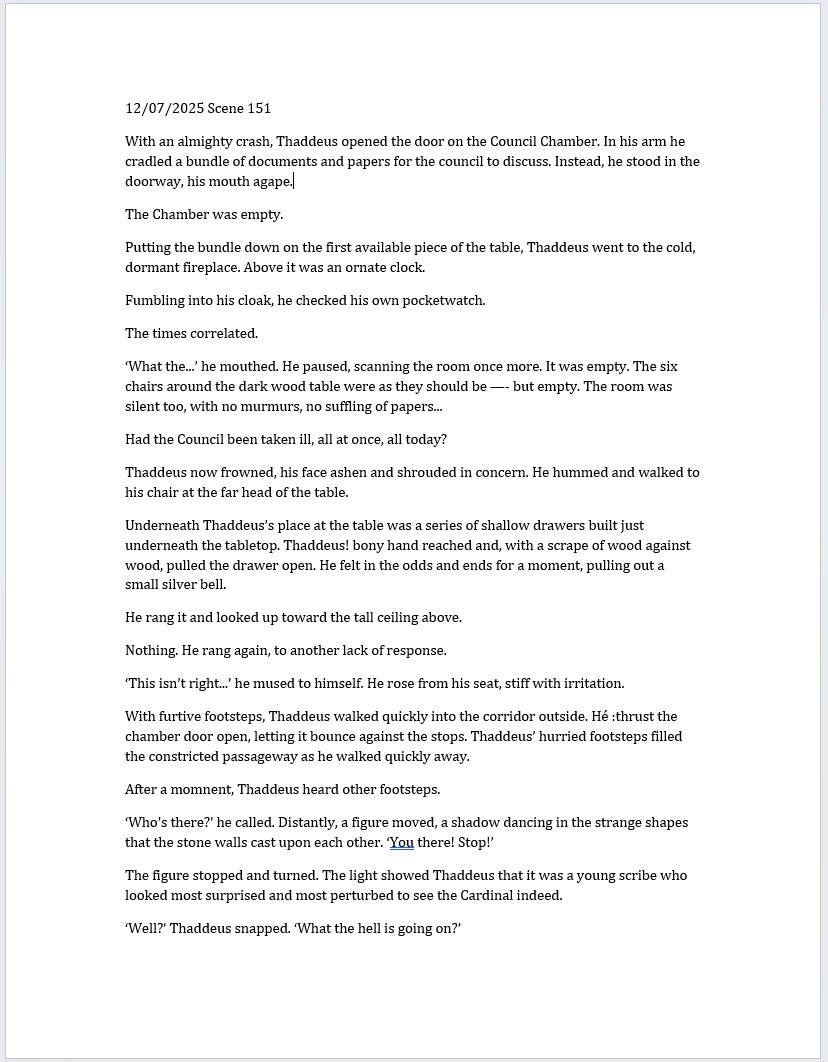
Now, this might not look like much – it’s just a plain Word document after all – but in seconds the AI created what I would’ve needed to spend about 10-15 minutes doing for that one page. It wasn’t perfect, and i had to nudge ChatGPT to follow the instructions more precisely, but it completely removed the donkey work that I had been dreading.
This setup lets me indulge my more artistic side and switch off: to sit down, go analogue, and type as if I were a novelist from a pre-digital era. The difference is, I can now do it without sabotaging my productivity. I’m no longer anxious about doubling my workload, and that actually encourages me to reach for the typewriter more often.
A long-standing motto for me is that when writing becomes work, I will stop writing. At the end of the day, writing for me is a hobby that I enjoy, and if this tool can help me to enjoy the writing – when I choose to take a break from staring at a monitor and instead look out the window while I type away with careless abandon – then I am ready to embrace it.
NB: And before anyone points it out… yes, I’m aware I’m “uploading my work to AI.” I’m not worried. What I send off disappears into the digital ether, diluted among billions of other words. AI isn’t stealing my work, and that’s not a debate I’m interested in having. I’m interested in tools that make writing more enjoyable.
 Richard Holliday - Author
Leave a Comment