As someone who sits on the autistic spectrum and who enjoys reading, for a long time I felt I have been particular pernickety about my reading experience. For a while I chalked this up to being, well, fussy; however I’ve had a recent epiphany of sorts that this experience isn’t (just) that, but it’s intrinsically related to my being autistic.
As someone on the autism spectrum, and especially fairly recently, I have found that I am susceptible to various sensory joys (and, indeed, sensory disappointments) that I try to both aim for and avoid.
An example of a sensory disappointment from my everyday life would be something as simple as eating – I very much avoid foods where I have to handle messy, greasy or sticky foods with my hands directly – for instance, I will eat pizza with a knife and fork without fail as I simply do not enjoy the sensation of grease, sauce or anything on my hands.
How does this relate to reading? Easy – reading, to me, is a physical and sensory experience all its own. I have developed a very strong preference to read paperback books that I would like to explore in a bit more depth and hopefully people understand more.
Trim Size
I enjoy reading paperback books, but a legitimate purchasing decision, for me, will be the trim size, otherwise known as the physical size of the book as an object. In the UK, the “standard” size for a novel or paperback book is B-format (129 x 198mm or 5.1 x 7.8 inches). There is also a smaller, “mass market paperback” size available. Here’s why trim size is important:
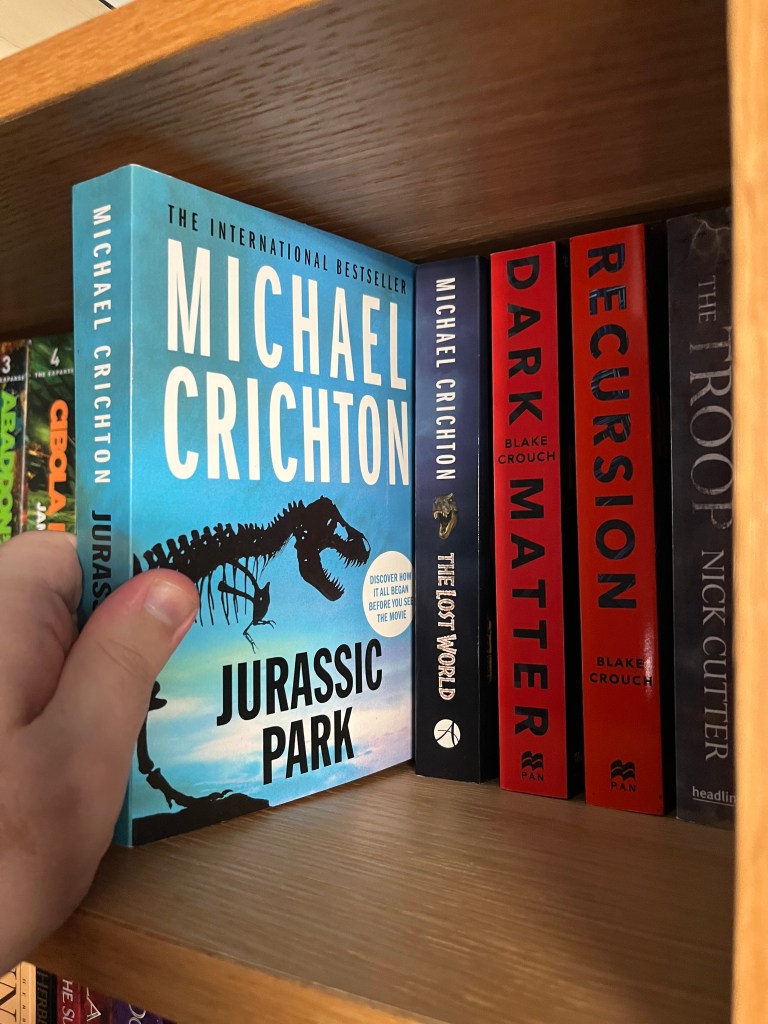
- I use a series of IKEA Billy bookcases to store my books. These common book-cases have shelf mounting holes that allow the shelves to be configured in a way that allows for tight, consistent storage of B-format books, like in the image above. Books that do not fit these shelves have to go onto the larger middle shelves where my off-size books live. This means that series or authors may find their books across multiple shelves or not lined up in a proper order.
- The arrangement of my bookshelves may not necessarily be a sensory disappointment and instead by an OCD-related disappointment, it’s a disappointment nonetheless
- Books that use very large trim sizes – often self-published or independent books – with high page counts may even be uncomfortable for me to hold and read. Books that I find physically uncomfortable to read will not get read.
- Large books are hard to keep in good condition. As a paperback reader I also take great caution to maintain my books in good condition. I have even bought some “library-style” plastic covers to slip on books that I take out to read as I do not want the corners or covers to become damaged. Large books cannot fit into these protective covers.
- Trim size, incidentally, is the main reason I choose paperbacks over hardbacks, as hardbacks are bulky to hold and read.
Page Colour
Pages should, as with most traditional novels, be cream or off-white in colour.
Cover Finish
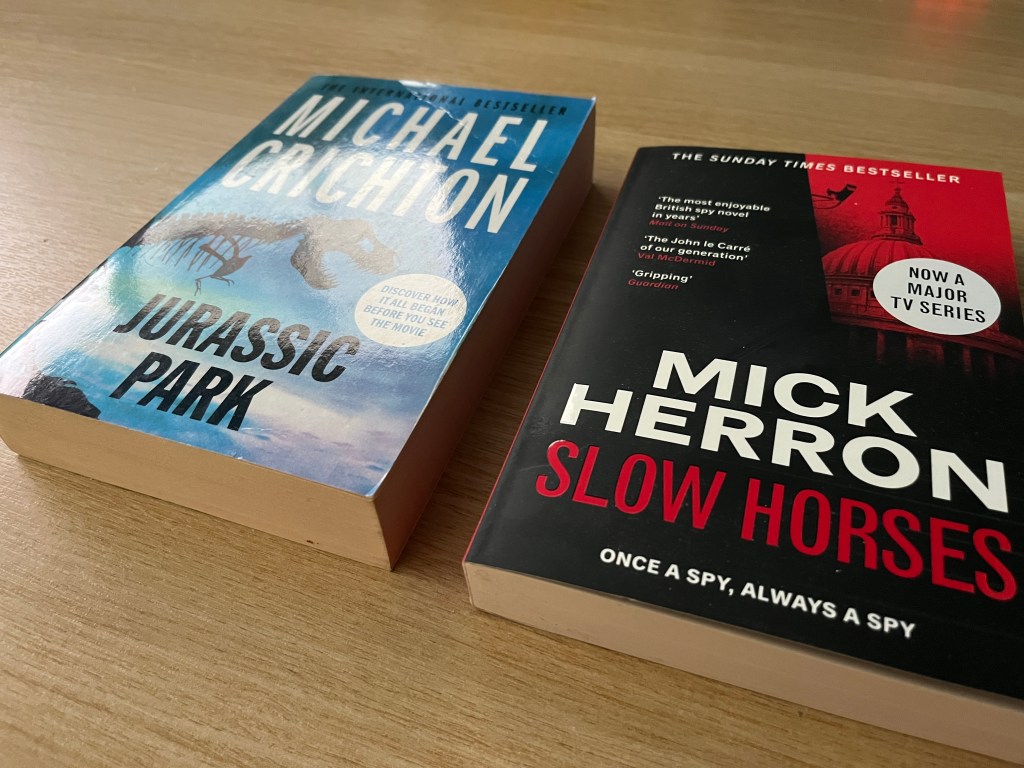
I have a strong preference for glossy covers:
- Glossy covers are easier to maintain and protect as they are more hardwearing and can be more easily cleaned, and are less-easily marred or marked.
- Matte covers – especially those with large areas of solid and/or dark colour (such as Slow Horses above), attract ugly fingerprints that are hard to remove. The fact that I will leave fingerprints on these cover finishes does put me off wanting to handle them as I feel obliged to protect and preserve my possessions.
- Amazon-printed matte books tend to have a waxy-like texture that I absolutely can’t stand holding as I don’t enjoy the sensation of the book in my hands
There is some strange notion that glossy covers are somehow for “lower quality books” but I find that’s rarely the case. Certainly the decision should come down to how the finish enhances – or hinders – the art style of the cover.
Why not just use a Kindle?
The question does remain that, if I’m so particular about how I read in paperback, why I don’t use my Kindle to read ebooks where the experience, by design, is much more customisable and less at the whim of a publisher/author?
I stopped using my Kindle regularly years ago as I found I much prefer to hold a book in my hand and be able to experience those sensory joys when reading – feeling the pages, the weight in my hands, seeing my progress at a glance with how much I have left… and yes, even the scent sometimes.
It’s hard to quite quantify why I find the ebook experience so underwhelming now compared to reading books in paperback, but I have written before about how I turned my back on ebooks, despite clear technical advantages.
However I would conclude by saying that, ultimately, I read for pleasure – and the medium is part of the pleasure in my opinion, so if a book disappoints me before I’ve even turned a page due to some of the choices made by the publisher or author then it sets is on an uphill slope. And while I realise that, to a degree, this is me being quite fussy and particular, as reading is a leisure activity to me, I am entitled to my views.
I’d be interested to hear what other autistic people feel about sensory joys that they are aware of in both reading and any other sphere.


 Richard Holliday - Author
Leave a Comment